
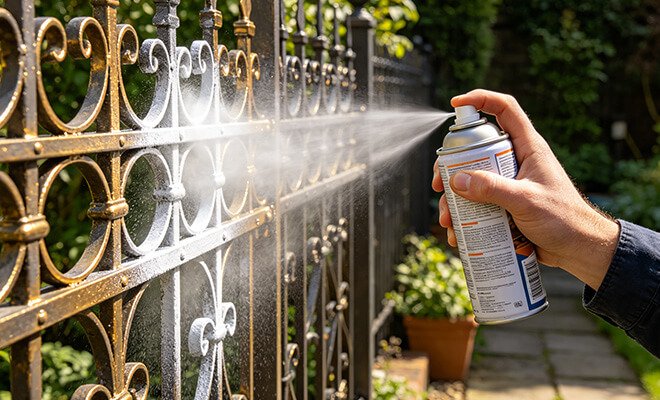
Many users store leftover aerosol spray paint for DIY touch-ups, industrial maintenance, and furniture restoration. Over time, solvent evaporation, pigment separation, propellant leakage, and chemical aging can cause spray paint deterioration. Deteriorated spray paint leads to common coating failures including uneven spraying, sputtering, poor coverage, peeling, and non-drying film. Worse, damaged aerosol cans may bring potential safety risks during use.
If you are unsure whether your stored self spray paint is still usable, follow these three authoritative testing steps to accurately judge paint deterioration, avoid construction defects, and ensure safe operation.
Step 1: Visual & Physical Inspection (Primary Screening)
Physical appearance and shaking tests are the fastest ways to eliminate severely deteriorated and unsafe spray paint cans before spraying.
1.1 Can Body Condition Check
Aerosol spray paint is a sealed pressure container. Any abnormal changes on the can body indicate seal failure, internal pressure imbalance, or ingredient degradation.
Discard the can immediately if you find:
Can bulging, deformation, local swelling or dents
Severe rust, cracks, or tiny leakage on the tank surface
Loose nozzle or continuous gas leakage
These symptoms mean the internal sealing system is damaged. The paint formula has likely deteriorated, and the pressure imbalance may cause safety hazards during spraying.
1.2 Standard Shake Test (Core Consistency Judgment)
Every aerosol spray paint contains a steel mixing ball for pigment blending. The shaking sound directly reflects the internal liquid status and formula activity.
Vigorously shake the can for 30 seconds to 1 minute before inspection:
Normal usable status: Clear, smooth rattling sound of the steel ball rolling freely inside the can, which means the paint liquid and propellant are sufficient, and no solid agglomeration occurs.
Deteriorated & unusable status:
No sound or extremely weak rolling sound: Caused by severe solvent evaporation, propellant loss, or complete pigment solidification. The paint cannot be atomized normally.
Turbid heavy sound with obvious hard-block collision feeling: The pigment has severely precipitated, layered, and clumped. Manual shaking cannot remix the solidified mass, resulting in unsprayable residue.
Step 2: Spray Trial Test (Most Direct & Accurate Judgment)
The spray test is the most reliable method to verify spray paint performance. Conduct trial spraying on waste cardboard in a fully ventilated environment to check atomization effect, spray pattern, and paint consistency.
2.1 Normal Spray Performance (Qualified Paint)
The paint ejects in a uniform, fine mist with stable and continuous output. The color is consistent, without intermittent spraying, splashing, particle separation, or liquid dripping. The paint forms a smooth and even base film quickly.
2.2 Deteriorated Spray Performance (Expired/Bad Paint)
If the spray paint shows any of the following phenomena, it is confirmed deteriorated and not suitable for formal coating:
Irregular spraying: Liquid droplets, floccules, solid blocks instead of uniform mist; intermittent ejection or only gas output without paint mist
Unstable spray pressure: Frequent sputtering, sudden thick and thin spray output
Abnormal texture and color: Visible coarse particles, color darkening, graying, or chromatic aberration, unable to form a continuous and flat paint film
Step 3: Odor & Film Formation Auxiliary Verification
For spray paint with minor aging symptoms that pass the above two tests, further verify deterioration through odor changes and final film-forming effect.
3.1 Abnormal Odor Judgment
Qualified fresh spray paint only has a mild, standard solvent smell. If the can emits sour, rotten, moldy, or pungent peculiar odor, the internal paint has undergone chemical decomposition and qualitative change. Such paint has lost formula stability and will cause poor adhesion and film failure after construction.
3.2 Abnormal Film Formation Symptoms
Even if the spray looks normal at first, deteriorated paint will show defects after construction:
Ultra-slow drying or permanent sticky surface
Film cracking, powdering, peeling, or blistering after curing
Weak hardness and poor scratch resistance after full drying
These problems prove that the paint resin and solvent components have failed, and the coating protection and decorative functions are completely lost.
Key Tips to Avoid Misjudgment
Long-stored spray paint needs sufficient shaking before use; slight precipitation is normal and does not mean deterioration
Nozzle clogging can be cleaned and fixed, while internal paint agglomeration is irreversible deterioration
Unopened spray paint with complete can condition and normal shaking sound can still be used slightly beyond the shelf life after trial spraying
Final Conclusion
Spray paint deterioration is mainly caused by solvent volatilization, propellant leakage, pigment agglomeration, and chemical aging. By conducting can inspection + shake test + spray trial + film verification, users can accurately distinguish normal aging and real deterioration. Abnormal cans and deteriorated paint must be discarded to avoid rework costs and potential safety hazards.